Quick Reference
The tables you reach for mid-game. Each card links to the full rule in the Rules tab.
On your activation Gameplay
- First activation (or after defeat): deploy on your Base hex, or adjacent to the Carrier's middle hex.
- Shield Upgrades flip face up (reactivate).
- Advance up to 3 hexes (free, +1 per Speed).
- Take exactly one Primary Action.
- Use each Command ability once.
- Play up to one Tactics card.
- End on/adjacent to an Objective to contest it.
A unit can't end its movement on a Base. Freshly deployed units must move at least 1 hex.
Primary Actions Pick one
| Action | TL | Effect |
|---|---|---|
| Attack | weapon | Attack with an equipped weapon or a Tactics card weapon |
| Dash | 2 | Move up to 2 hexes (Speed doesn't apply) |
| Energize | 2 | Gain 1 Energy |
| Rescue | 2 | Rescue adjacent allied Garrison, +2 VP |
An action whose TL cost is reduced to 0 counts as an additional action, so it doesn't use up your Primary.
Attack sequence 9 steps
- Declare the attack (target + weapon). Use abilities before this.
- Check range and Line of Sight.
- Pay the TL cost.
- Before Attack Roll responses.
- Roll attack dice (d10 × Strength).
- After Attack Roll responses, then Disarm rerolls.
- Resolve critical hit effects.
- Damage = hits − Shields. Fracture triggers. 0 HP is defeated.
- After Combat Damage responses.
Both players responding at once: attacker resolves first, then defender.
Hits & crits d10
| Roll | Result |
|---|---|
| 1 | Always a miss |
| 2–8 | Hit if roll + Accuracy ≥ 4 |
| 9–10 | Critical hit: always hits, triggers crit effect |
Accuracy never turns a roll into a crit. A crit effect triggers once per attack unless it says otherwise.
Accuracy modifiers Cumulative
| Situation | Acc |
|---|---|
| Target at lower elevation | +1 |
| Target at higher elevation | −1 |
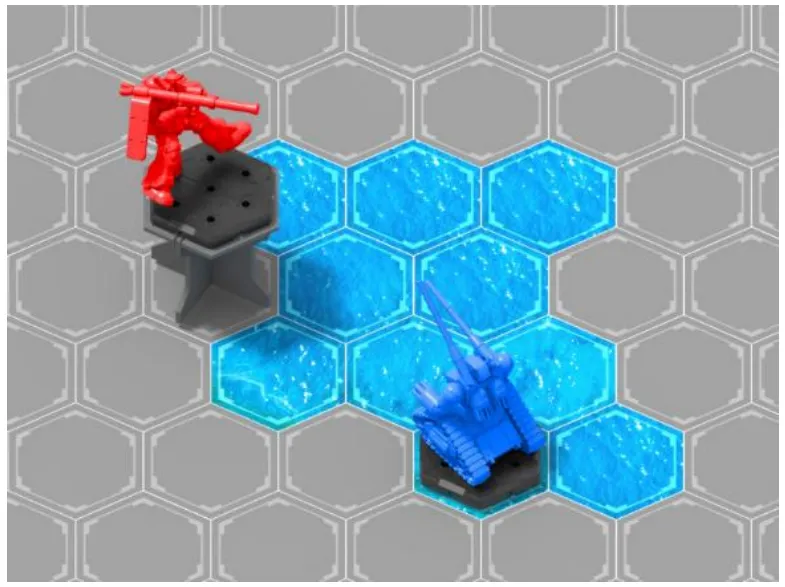
| Target in water / debris field | −1 |
| Attacker in water / debris field | −1 |
| Minovsky Particles, non-adjacent target, either side inside | −2 |
Water: both in water is −2. Minovsky is not cumulative: max −2 even if both are inside.
Movement costs Hexes
| Case | Cost |
|---|---|
| Advance | 3 (+Speed) |
| Dash | 2 for 2 TL |
| Starting move while Engaged | −1 hex |
| Starting move in water / debris | −1 hex |
| Each elevation level climbed | +1 hex |
| Moving down | free |
| Impassable Terrain | Hover only, can't end there |
Status effects 1 of each max
Disarm: next attack rerolls all hits, and its crit effects can't trigger. Removed after the reroll.
Fracture: next time it takes 3+ combat damage from one attack, it takes +3. Direct ability damage doesn't count.
Slow: next Advance moves 0 hexes. Doesn't affect Dash.
Status effects only apply to units and Carriers, never Garrisons or RWS.
Victory points Scoring
| Event | VP |
|---|---|
| Defeat enemy unit | unit's VP |
| Defeat enemy Garrison | 2 |
| Rescue allied Garrison | 2 |
| Each Objective you control at the end of each Phase | 5 or 8 |
| Other scenario goals | per scenario |
Objective values depend on the scenario: see Scenarios. Tie at the end of the game: the last player to act wins.
End of a Phase After round 10
Phase 1 ends: score Phase 1 Objectives and goals, then draw 3 Tactics cards, then start Phase 2 at round 1.
Phase 2 ends: score Phase 2 Objectives and goals, then compare VP.
A game is 2 Phases × 10 rounds = 20 rounds. Spending more than 10 TL in one activation pushes the unit into the next Phase.
When a unit is defeated 0 HP
- Opponent scores its VP value.
- Remove it to your Reserve and move its TL token +2.
- Reset HP and clear status effects. Keep Energy and Upgrades.
- Drops any carried Objective in its hex.
- Redeploys on its next activation. If defeated during its own activation, that activation ends.
Push / Pull Forced move
- Each hex must be farther from (Push) or closer to (Pull) the source.
- Ignores Engagement and terrain penalties.
- Can't go up in elevation: collides instead.
- Collision: stop, and everyone involved takes 2 damage (Shields prevent it).
- Can't Pull an enemy that is already adjacent at the same elevation.
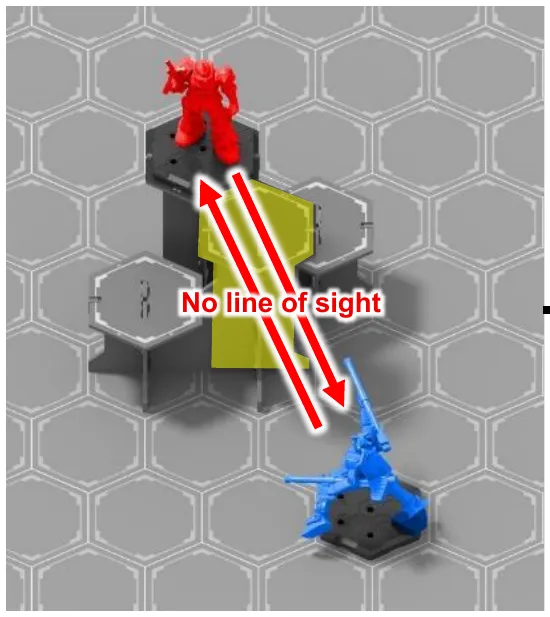
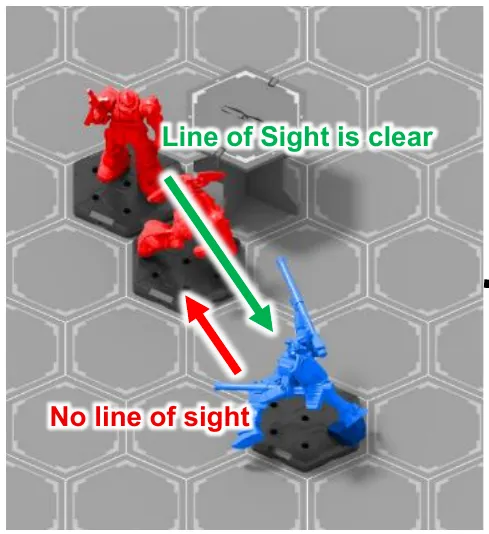
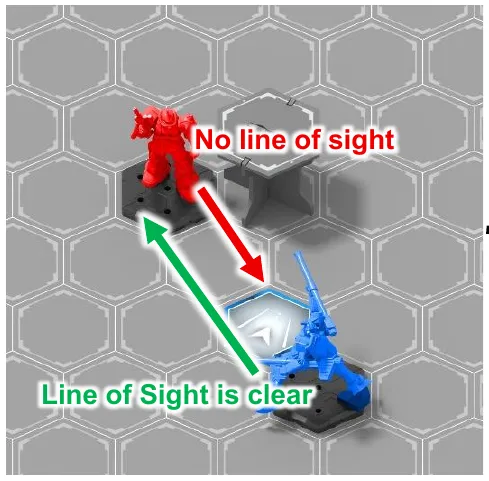
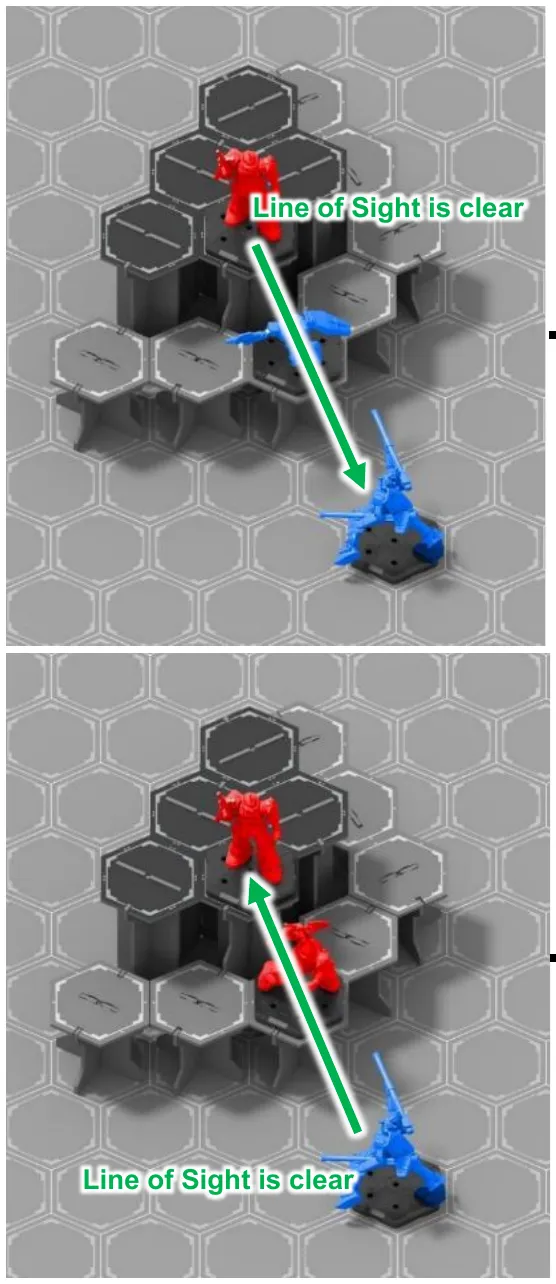
Line of Sight blocked when… Range 2+
- Terrain higher than both units.
- An enemy unit, Garrison or structure (other than the target) at the same elevation as both.
- Different elevations: terrain or enemy at the higher unit's elevation.
Allies never block. Adjacent targets don't need LoS. "Within X hexes" ignores LoS. Line exactly between two hexes: the acting player picks.
Start a Game
Overview & Setup
Overview p.5
Gundam Assemble is a tactical miniatures skirmish game. Every game is built around a scenario that defines setup and victory conditions. Players earn victory points for defeating enemies, capturing key Objectives and completing mission-specific goals. The player with the highest score wins.
Setup p.5–6
Before play, each player builds a squad of units and a Tactics deck. Then:
- Place the game board in the centre of the play space.
- Add to the board, as the scenario indicates: Bases or Carriers, Garrisons, Upgrades, Energy, scenario Objectives, Terrain.
- Place within reach of all players: additional Upgrades, status effect tokens, Energy, attack dice, Objective control tokens, and any other unit or scenario components.
- Place the Timeline track near the board.
- Each player reveals their squad. Each unit has a miniature, a unit card (stats, weapons, abilities), a Timeline token, and sometimes unit-specific tokens.
- Place each unit's Timeline token on the track at its starting Timeline value. Several of your units on the same space: stack them in your preferred order.
- The player whose unit has the lowest starting Timeline value acts first. If tied, each player rolls one attack die; higher roll plays first.
- Resolve Setup abilities in activation order, starting with the first player. A player with several resolves them in any order.
Card Types
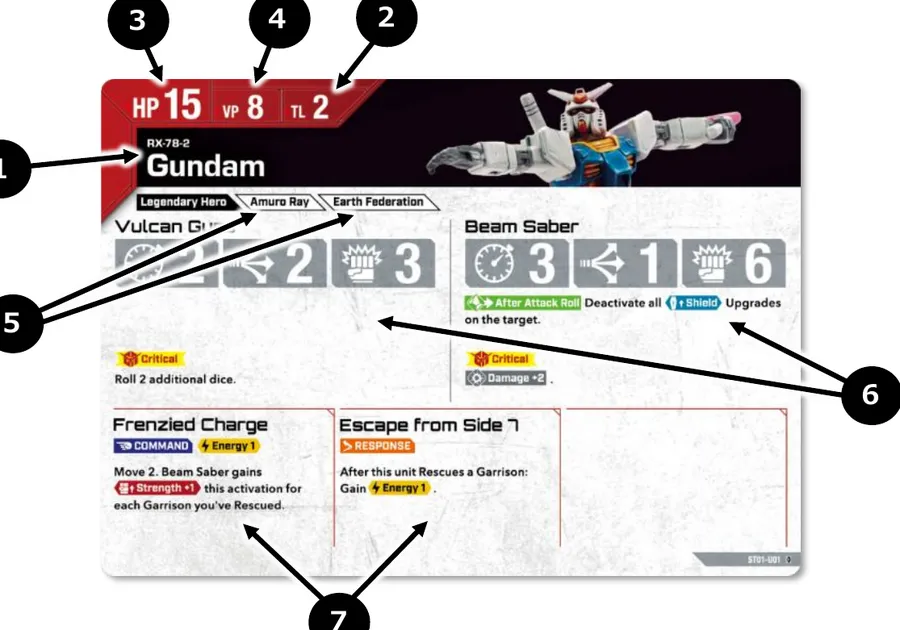
Unit cards p.7
- Name and model number.
- Starting Timeline value: where the unit starts on the Timeline track.
- Hit points: at zero the unit is defeated.
- Victory point (VP) value: the opponent earns this for defeating it.
- Traits: pilot, faction affiliations and unique characteristics. They decide which Tactics cards you can include and are referenced by abilities. Each unit also has a signature title that sets it apart from other units of the same name.
- Weapons.
- Abilities.
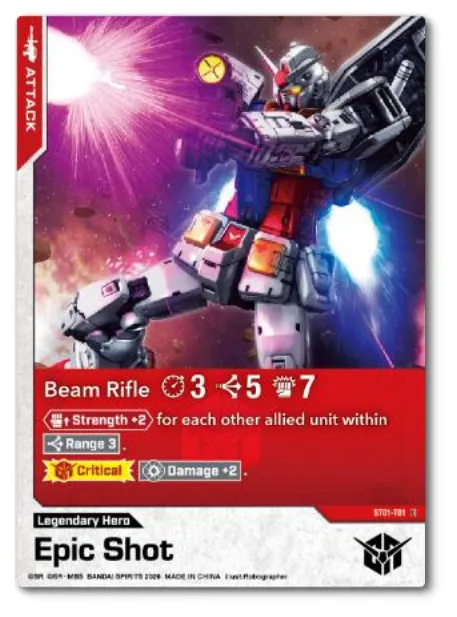
Tactics cards p.8
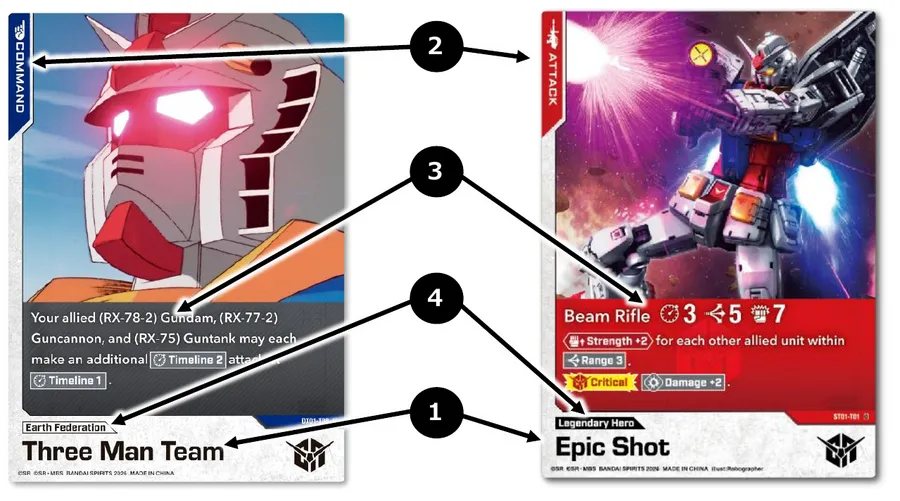
Each player starts with a deck of nine Tactics cards, shuffles it, and draws three at the start of the game.
- Card name.
- Type: Attack, Command or Response, which sets when it can be played. Some have a Timeline cost to pay when played. Some show a unit's signature title next to the type; only a unit with that matching title can play them.
- Effect when played.
- Some specify a faction for deck building: the card can only be included if your squad has at least one unit of that faction. Cards with no faction or named character have no deck-building requirement.
The Timeline
Object of the game p.9
A game has two Phases of 10 rounds each: 20 rounds in total. Earn VP by defeating enemy units and Garrisons, rescuing allied Garrisons and completing scenario goals. Most VP at the end wins.
Timeline track & setup p.9–10
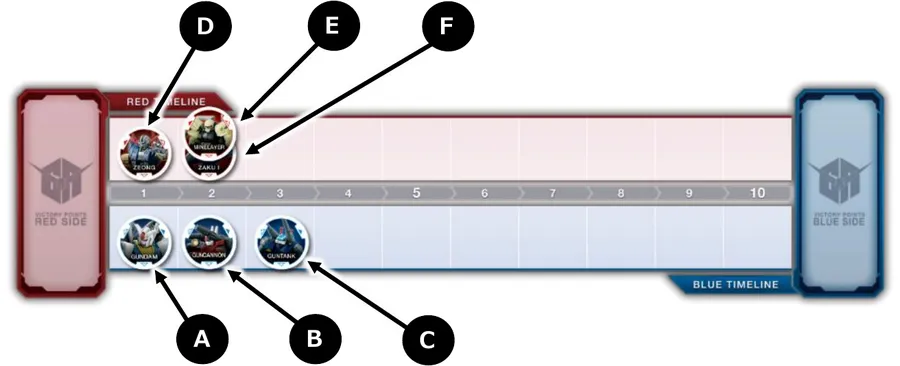
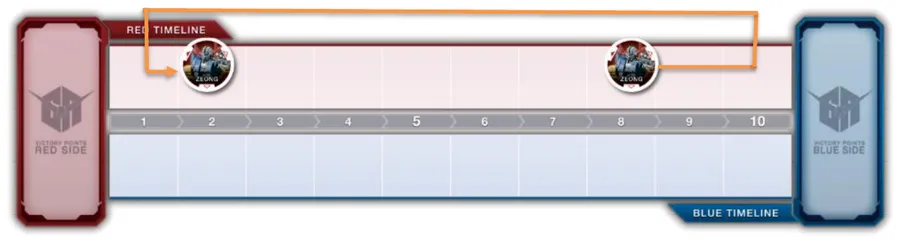
The Timeline (TL) track has 10 spaces, one per round of a Phase, and two sides, one per player. Place your tokens on your side. Units move up the Timeline as they activate.
When several of your tokens share a space, stack them; the top token acts first.
Progressing through the Timeline p.10–11
Play starts at round 1 of Phase 1. Activate every unit on a space before moving to the next; skip empty spaces.
- Multiple of your units on one space: activate the top of your stack first.
- Both players have units on one space: alternate, with the player who acted most recently acting last. On the very first activation of the game, roll off (higher plays first).
- After round 10 the Phase ends and the next Phase begins at round 1. Games normally end after two Phases.
Timeline costs p.11–12
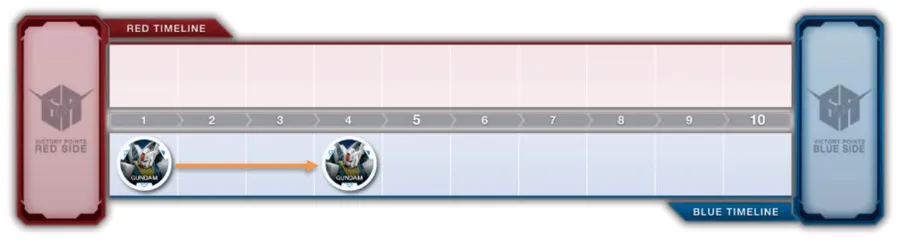
Most actions have a TL cost. Pay it by moving the unit's token forward that many spaces, immediately after declaring the action and before resolving it.
- Passing space 10: advance to 10, wrap to space 1, and keep counting until the full cost is paid.
- More than 10 TL spent in one activation: the unit moves into the next Phase and won't act again this Phase.
- Landing on a space with allied tokens: place yours on the bottom of the stack.
Ending a Phase p.12
The Phase ends after units acting in round 10 finish, or when no tokens remain in the current Phase.
- First Phase: resolve Phase 1 scenario Objectives and score VP, then draw three new Tactics cards, then begin Phase 2.
- Second Phase: resolve Phase 2 scenario Objectives and score VP, then compare totals to decide the winner.
Deploying & Activating
Deploying your units p.12–13
Units start in your Reserve. The first time you activate a unit, deploy it: place it on your Base's hex, or adjacent to the middle hex of your Carrier, then activate it immediately. Units can't end movement on a Base, so they must move at least one hex before ending the activation.
Blocked deployment: pick a hex you could normally deploy to, treat it as empty, deploy, and immediately Advance to a legal hex. If there is nowhere to deploy and no legal hex to Advance to, the unit spends 2 TL to Energize and stays in Reserve until its next activation.
Defeated units return to Reserve and redeploy the next time they activate. Abilities that change redeployment don't affect the first deployment.
Units in Reserve can't be targeted by attacks, can't gain status effects, and some of their abilities may be inactive.
Activating your units p.13–14
When a round contains your units, activate them. Each activation you must take one Primary Action and may take the others below.
Advance: the basic move, up to three hexes. Card or ability Advances are in addition to this one.
Primary Actions (choose one):
- Attack: spend the weapon's TL to attack with an equipped weapon or one provided by a Tactics card.
- Dash: 2 TL, move up to two hexes. Terrain and enemies affect it.
- Energize: 2 TL, place an Energy token on the unit card. Units can hold several.
- Rescue: 2 TL, rescue an adjacent allied Garrison and score 2 VP.
Additional actions: many abilities grant extra actions of a stated type, one per use. An action whose TL is reduced to 0 counts as an additional action of its type, so a 0-TL Dash doesn't use your Primary.
Command abilities: each may be used once.
Tactics card: up to one per activation. Reveal it, announce and resolve the effect, then discard it face up. Discard piles are public and cards don't return unless an effect says so. Some cards attach to a unit card and stay in play for the duration stated on them.
Movement
Moving p.15
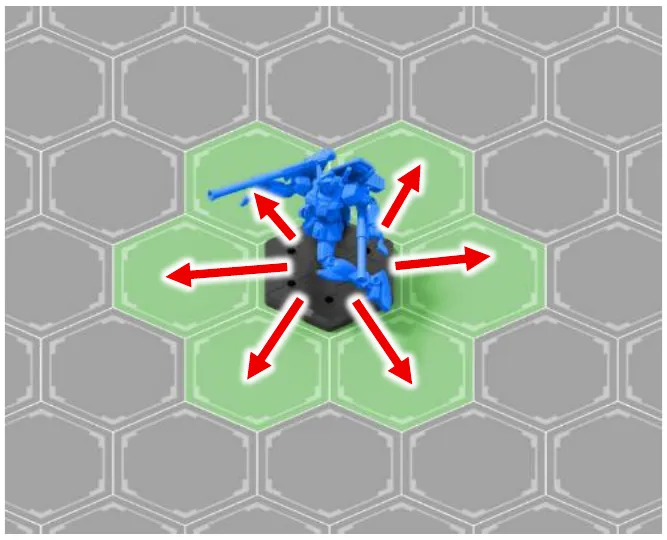
- Move one hex at a time in any direction, up to your maximum. You can stop early, but if you move you can't end in your starting hex.
- You can't move through enemy units, Garrisons, Carriers or structures (such as Bases). You can move through allies and allied structures.
- You can't end in a hex with another unit or structure unless stated.
- No other actions mid-move: finish moving before attacking.
- Multi-hex units must have all hexes at the same elevation when ending a move.
- All movement is optional.
Speed p.16
Each point of Speed (from abilities or Speed Upgrades) adds one hex to an Advance. Speed doesn't affect Dash or other movement.
Engagement p.16, 25
A unit adjacent to an enemy unit or Garrison at the same elevation is Engaged.
- −1 hex to all movement started while Engaged.
- Every attack must target at least one enemy it's Engaged with. An AoE attack is fine if it includes at least one Engaged enemy.
Effects that ignore Engagement ignore both the movement penalty and the attack restriction.
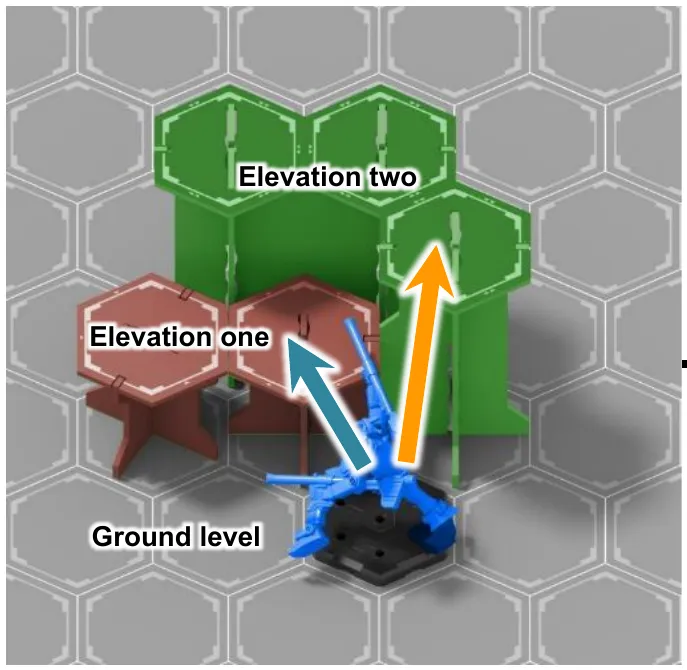
Elevation & movement p.17–18
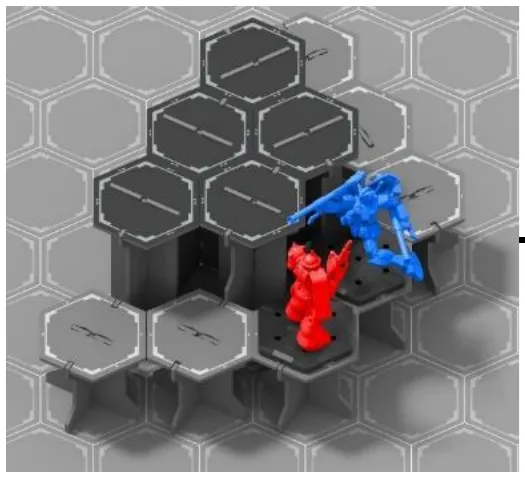
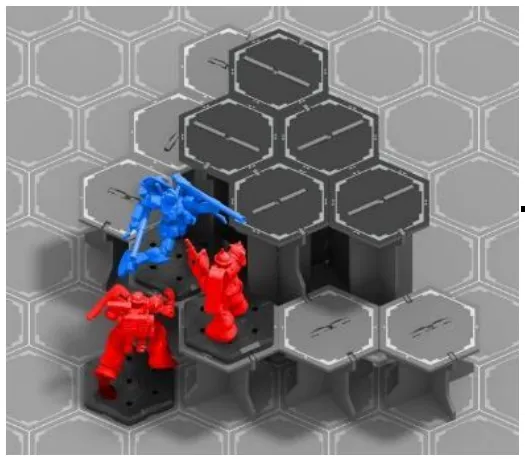
The lowest level is ground level; higher levels are height 1, height 2 and so on. Moving up costs +1 movement per level gained. Moving down costs nothing extra. A unit that can't pay the extra movement can't climb.
Jumping p.18–19
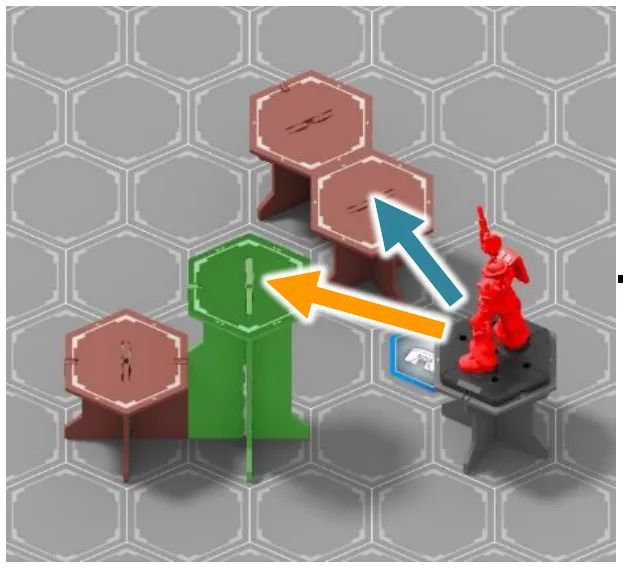
A unit that begins a move on elevated terrain jumps: its starting elevation counts as its elevation for the whole move. It can cross gaps and pass over enemies at lower elevations, paying extra only to go higher than where it started. No jumping from ground level. Jumping is part of moving, not a separate action.
Attacking
Declare an attack & choose a weapon p.19–20
Announce both the target and the weapon. That starts the attack sequence, so use any abilities you want before declaring; many can't be used during an attack.
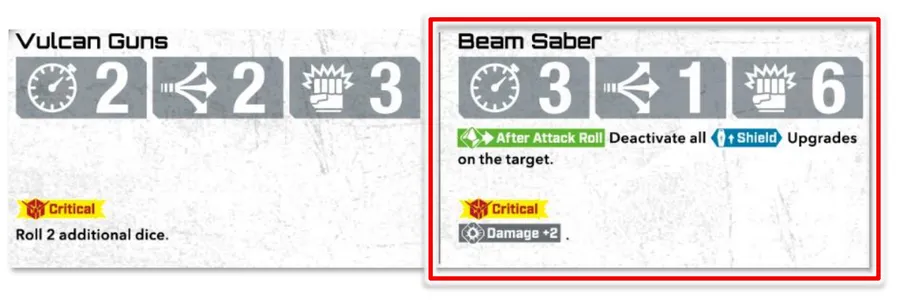
Weapon attributes:
- TL Cost: spaces the Timeline token moves.
- Range: maximum range.
- Strength: number of attack dice.
- Weapon Effects: trigger every time the weapon attacks.
- Critical Hit Effect: triggers on a critical hit.
Range p.20
Range 1 weapons hit adjacent targets only. Range 2+ reaches up to that many hexes. Elevation and terrain don't change range but may block Line of Sight.
"Within range X" vs "within X hexes": anything with a stated range needs Line of Sight. Abilities that affect targets "within X hexes" do not.
Line of Sight p.20–24
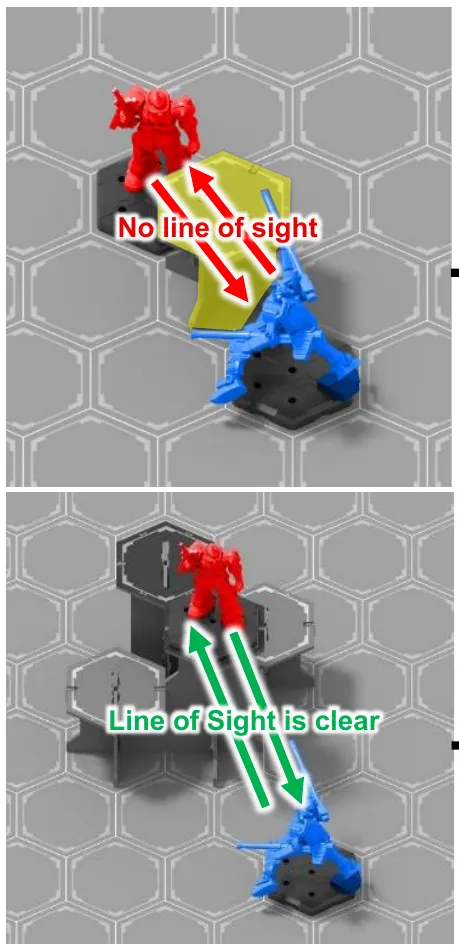
Needed for attacks and abilities at range 2+. Not needed for adjacent targets. Draw a line (a ruler helps) from the centre of the acting unit's hex to the centre of the target's hex.
Blocked if the line passes through:
- terrain at a higher elevation than both attacker and target;
- enemies other than the target at the same elevation as both;
- an enemy structure (such as a Base) at the same elevation as both.
Different elevations, also blocked if the line passes through terrain, or an enemy or enemy structure other than the target, at the elevation of whichever unit is higher.
A line running exactly between two hexes: the acting player chooses which hex counts.
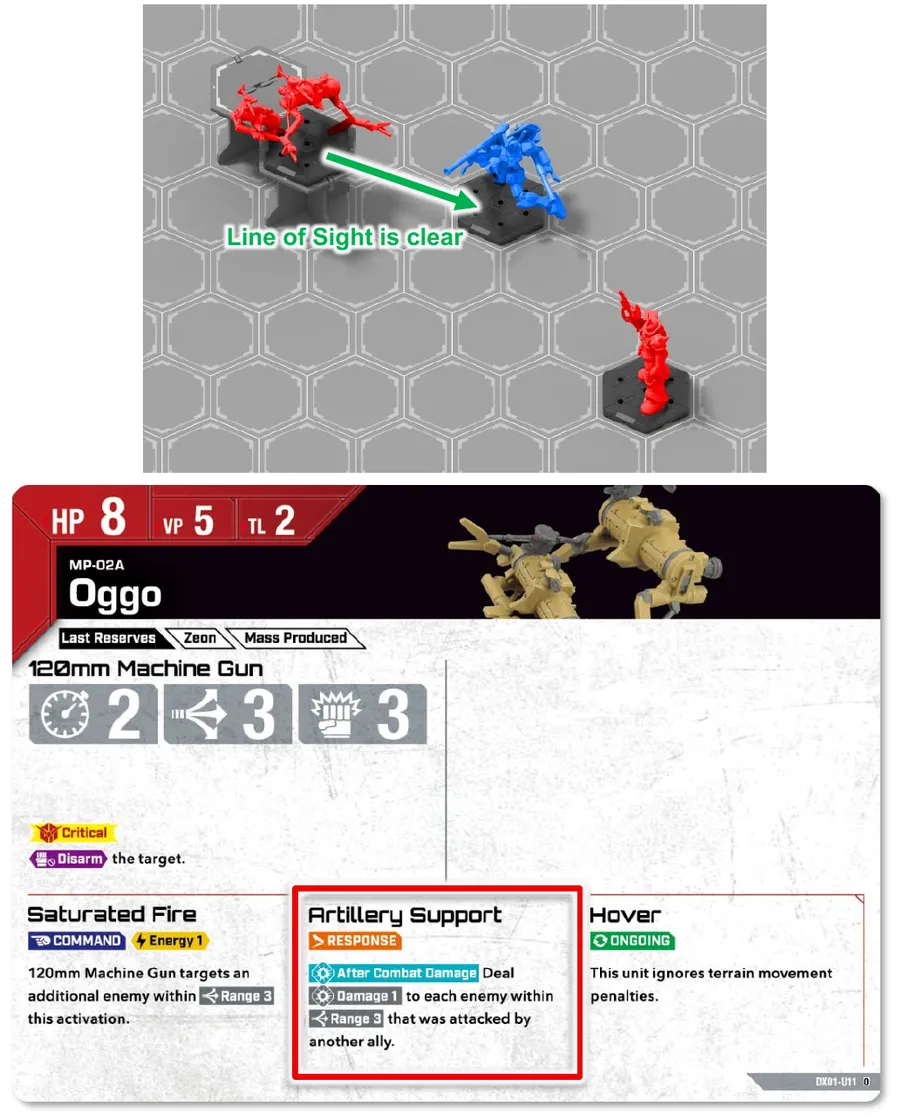
Abilities that need a target in range need LoS to that target only. Example: the Oggo's Artillery Support needs LoS to the enemy being attacked, not to the ally attacking it.
Ignoring Line of Sight p.25
Weapons and abilities that ignore LoS still need the target in range, but can hit units behind elevated terrain or other units.
Area of effect (AoE) attacks p.25
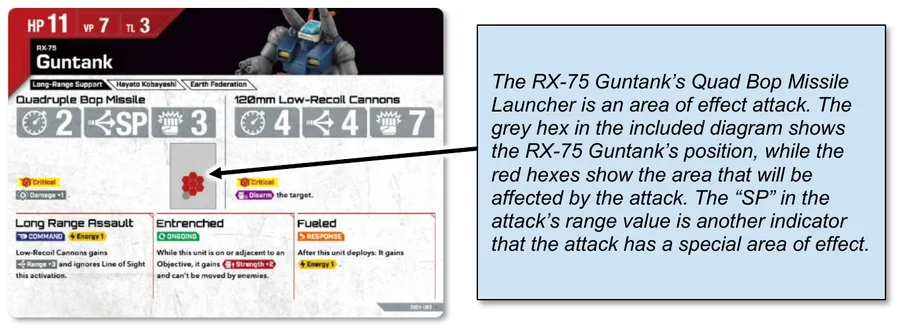
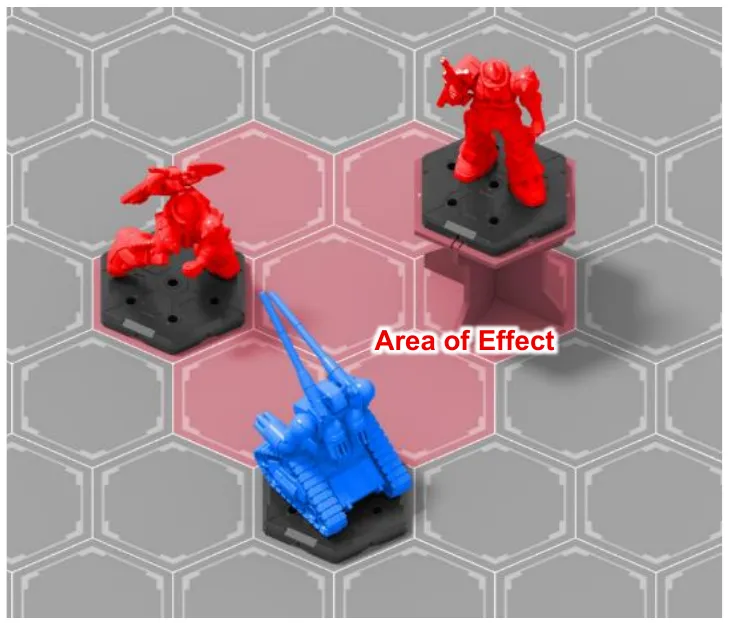
AoE weapons show a diagram: the grey hex is the attacking unit's position and the red hexes are the area the attack covers ("SP" in the range value marks a special area). When declaring, choose how to place the pattern. Targets still need range and LoS (unless the weapon ignores LoS), but AoE ignores units and Garrisons when checking LoS. Every enemy in LoS inside the pattern is targeted; you can't pick or exclude targets.
Attack timing & responses p.26
- Declare that you're making an attack.
- Choose an attack and check range and a clear Line of Sight to the target(s).
- Pay the Timeline cost.
- Players may respond with Before Attack Roll abilities.
- Roll your attack dice.
- Players may respond with After Attack Roll abilities. Disarm triggers after the attacker has resolved any other After Attack Roll abilities, then is removed.
- Resolve critical hit effects.
- Deal damage equal to hits minus opposing Shields. Fracture triggers when damage is dealt. Units at 0 HP are defeated.
- Players may respond with After Combat Damage abilities.
Each step resolves fully before the next. If both players want to respond at the same time, the attacker's abilities resolve first, then the defender's.
Attack rolls & multiple targets p.26–27
Roll a number of 10-sided attack dice equal to Strength, plus or minus modifiers, all at once.
Against multiple targets (AoE or extra targets) make one roll, then count hits separately for each target, applying terrain Accuracy per target. Strength or Accuracy modifiers from abilities that apply to some targets apply to all of them. Damage is dealt to all targets at once and can differ per target.
Hits, misses & Accuracy p.28
By default a die showing 4 or more is a hit. Accuracy adds to or subtracts from each die, except 1, 9 and 10. A 1 always misses; 9 or 10 is always a critical hit. Accuracy can't make a critical hit.
Elevation: targeting a higher unit is −1 Accuracy, a lower unit +1.
Critical hits p.29
Any 9 or 10 is a critical hit and succeeds regardless of Accuracy. Every weapon has a critical hit effect (some need several crits): extra damage, a status effect, destroying an Upgrade, and so on. Crit effects trigger once per attack regardless of how many crits are rolled, unless stated otherwise. Crit effects apply even if Shields prevent all damage.
Damage & Shields p.29
Each hit deals 1 damage. Each active Shield prevents 1 damage. Shields apply after all other effects; damage-reduction abilities apply before Shields. "Damage+X" adds X to the attack's combat damage.
Defeated units p.29
At 0 HP the opponent scores the unit's VP. Remove it to its owner's Reserve and immediately move its Timeline token two spaces forward (repair penalty). Reset HP to max and remove status effects. Energy and Upgrades stay. It redeploys the next time it acts. If defeated during its own activation, that activation ends immediately.
Cards & Abilities
General ability rules p.30
Resolve multi-effect abilities in printed order, each fully before the next. If an ability can't be fully resolved, resolve as much as possible. "Can't" beats "can": effects saying a unit can't do something override effects allowing it.
Command abilities p.30
Used only while activating a unit, once per activation each. Command abilities on unit cards, and Tactics cards naming a unit, require you to be activating that unit. They can't be used mid-action unless the ability says so.
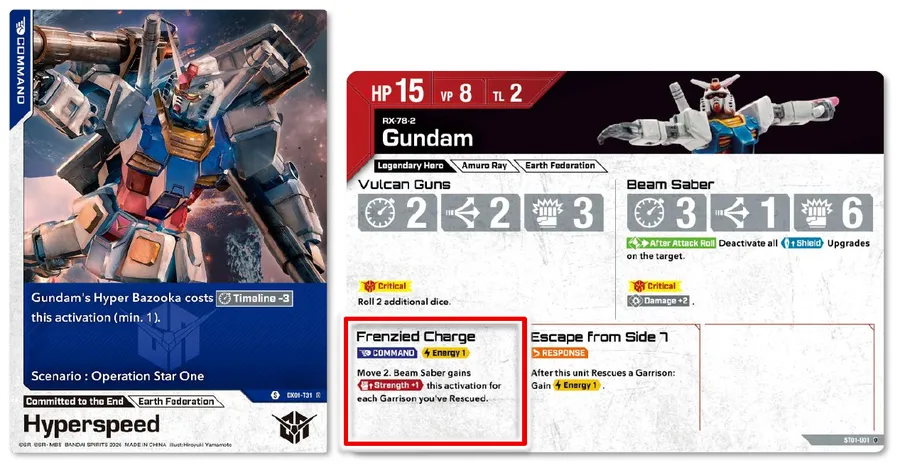
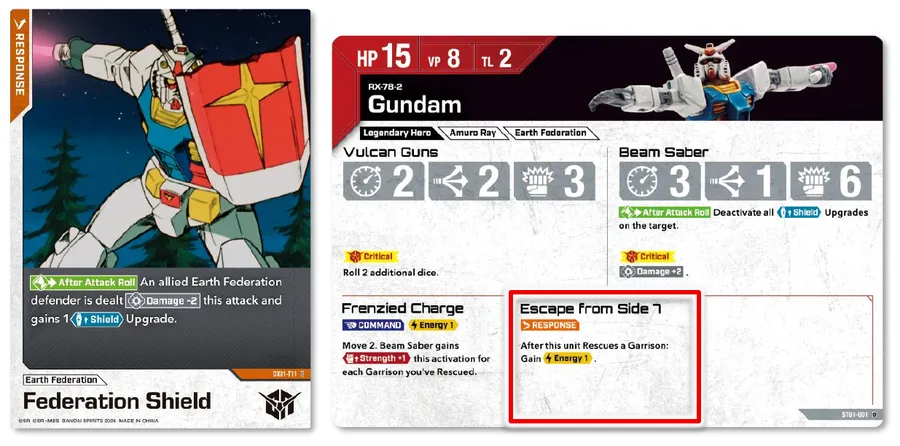
Response abilities p.30–31
Used when their stated trigger happens, whoever is acting. Resolve fully before resuming. You may combine several cards and abilities on one trigger, and reuse the same Response on separate triggers, but not the same ability twice on one trigger. AoE and multi-target attacks create a separate trigger for each unit. The active player decides first whether to respond.
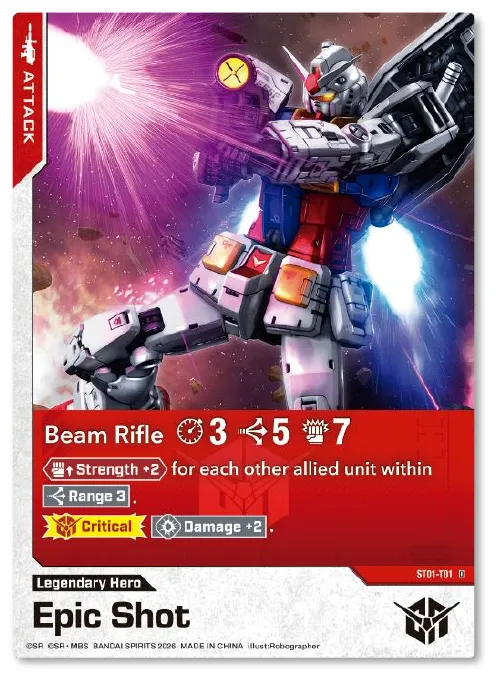
Attack abilities p.31–32
Abilities that attack with a unique weapon replace the Primary Attack Action, so you can't also make a standard attack that activation unless stated. They usually have a TL cost. Abilities granting extra attacks with weapons already on the unit card are in addition to the Primary Attack unless stated. Attack cards naming a unit need that unit to be activating.
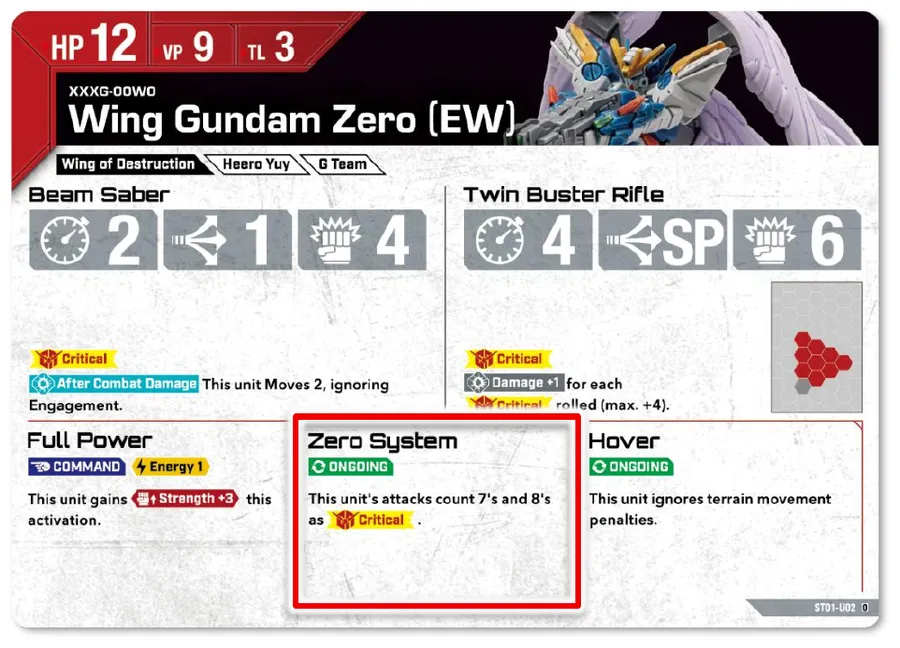
Ongoing & Setup abilities p.32–33
Ongoing abilities are active from the start, need no Energy and don't need activating (for example Wing Gundam Zero (EW)'s "Zero System" scores crits on 7s and 8s).
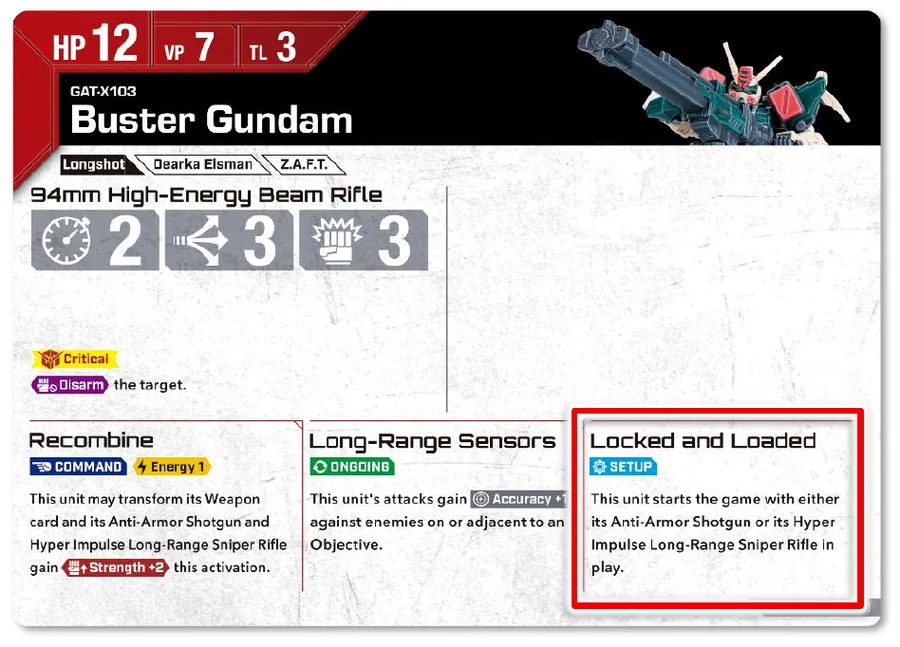
Setup abilities resolve during setup in order, starting with the first player; one player's several setup abilities resolve in any order (for example Buster Gundam starts with a special Weapon card in play).
Abilities requiring Energy p.34
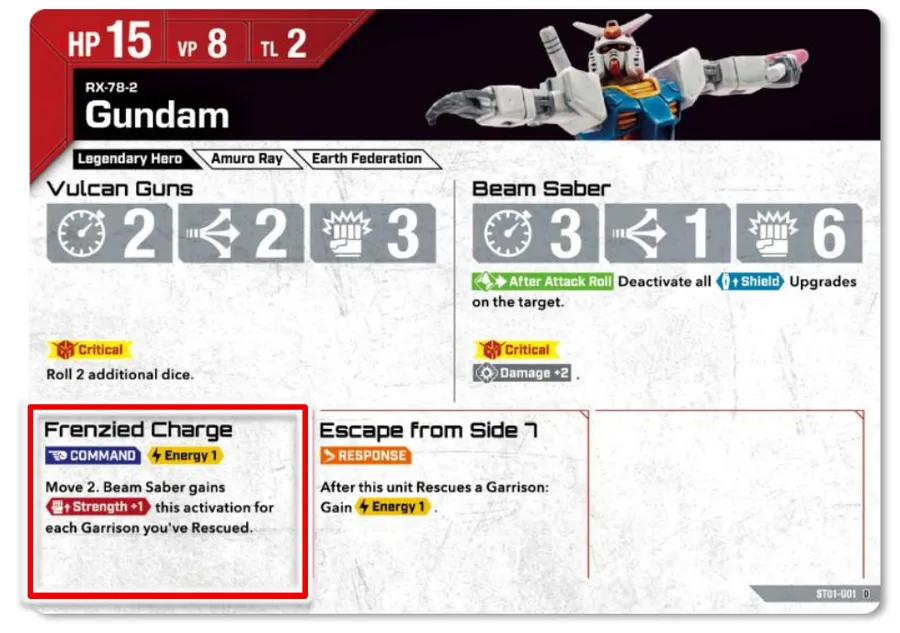
Energy can be used the same activation it is gained, but must be spent by the unit using the ability.
Ending your activation p.34
Once you've finished with the unit, its activation ends. When all units in the round have activated, play moves to the next round.
Status & Special Effects
Status effects p.34
Shown by tokens on the unit card. Only units and Carriers can have them, one instance of each at a time.
Disarm p.35
The next time the unit attacks, it must re-roll all dice that hit and can't trigger critical hit effects that attack. Triggers in the After Attack Roll step after the attacker's other abilities. Removed right after the re-roll.
Fracture p.35
The next time the unit would take 3 or more combat damage from one attack, it takes an additional 3. This triggers immediately when the damage is dealt and counts as attack damage. Then remove it. Direct damage from abilities doesn't trigger Fracture.
Slow p.35
The next time the unit Advances, it doesn't move. Remove after that Advance. Dash and other movement are unaffected.
Push p.35–36
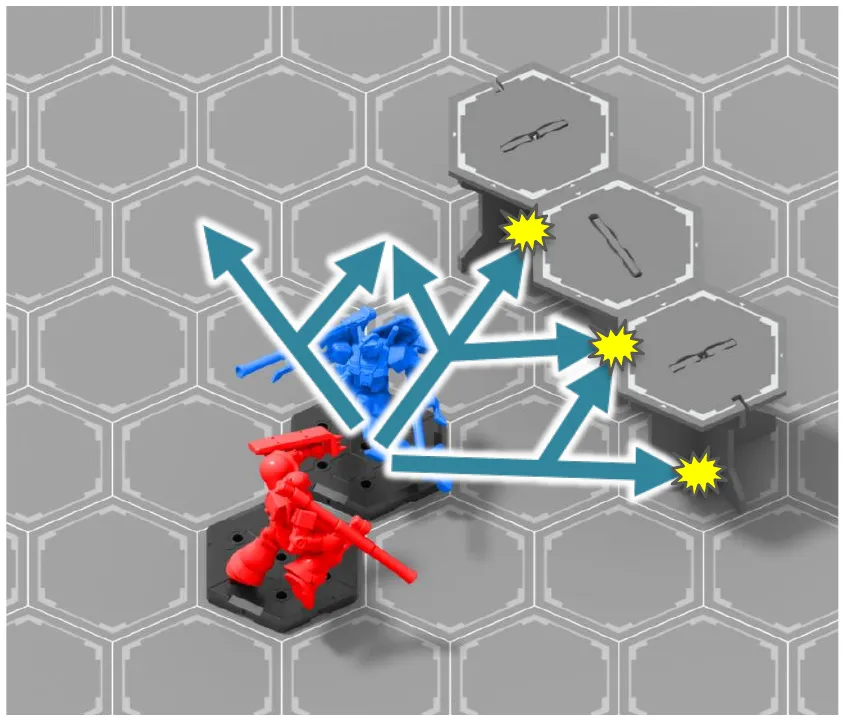
- Move the enemy away from the source up to the stated number of hexes (Push 1 = one hex). Engagement and terrain penalties don't apply.
- Can't be Pushed up in elevation: it collides with the terrain and takes collision damage.
- Each hex must be farther from the source than the last (count hexes).
- Collision with terrain or another unit: stop; everyone involved takes 2 damage; the Push ends.
Pull p.36–37
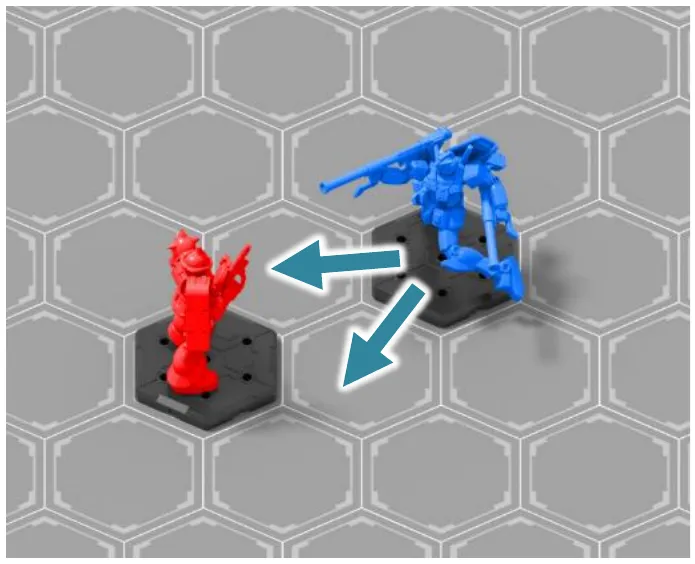
- Move the enemy toward the source up to the stated number of hexes. Engagement and terrain penalties don't apply.
- Can't be Pulled up in elevation: it collides and takes collision damage.
- Each hex must be closer to the source than the last.
- Collision: stop; everyone involved takes 2 damage.
- An enemy already adjacent at the same elevation can't be Pulled.
Pulling is optional. Use the shortest path; if two are equally short, either is fine.
Upgrades
Collecting Upgrades & Energy p.37
A unit that ends any movement action in, or deploys into, a hex with an Upgrade or Energy places it on its unit card. Passing through isn't enough.
Shield Upgrades p.37–38
When the unit would take damage, each active Shield prevents 1 damage, then flips face down (deactivated). At the start of the unit's next activation, flip them face up. Shields apply after all other effects.
Speed & Strength Upgrades p.38
Speed: +1 hex to Advance per Speed Upgrade. Strength: +1 attack die to every attack per Strength Upgrade, for the rest of the game.
Redistributing or taking Upgrades/Energy p.38
Move the tokens between unit cards. Shield Upgrades become active when redistributed or taken.
Elevation & Terrain
Elevation summary p.38
- +1 movement per level gained.
- Units on elevated terrain may Jump.
- Attacking down: +1 Accuracy. Attacking up: −1 Accuracy.
Special terrain p.39
| Terrain | Moving | Attacking |
|---|---|---|
| Water | −1 hex to moves started in water | −1 Acc vs targets in water; −1 Acc attacking from water; −2 if both |
| Debris field | −1 hex to moves started in debris | −1 Acc vs targets in debris; −1 Acc attacking from debris; −2 if both |
| Impassable | Only Hover units may pass; nobody can end there | None |
| Minovsky Particles | None | −2 Acc vs non-adjacent targets if the attacker is inside, or the target is inside; not cumulative (−2 max) |
Setting up terrain p.40
Some scenarios let players place terrain freely; agree on placement during setup.
Squad & Deck Building
Building your squad p.40
The scenario sets squad size; most use three or five units, and some add a Carrier. Pick any units. The only restriction: no duplicate unit card numbers unless the unit is Mass Produced. Mixing factions is allowed unless the scenario says otherwise.
Mass Produced units p.40
You can field several copies, but each miniature and its Timeline token must be clearly distinguishable and matched to its unit card (paint schemes, base markings, and so on).
Building your Tactics deck p.40–41
Exactly nine Tactics cards, following three rules:
- Signature Tactics cards show a unit's signature title and need that unit in your squad.
- Cards with a trait (Earth Federation, Zeon and so on) need at least one unit with a matching trait.
- One copy of each card.
Targeting restrictions p.41
Many cards only target units of a certain name or trait, as stated in the text. A Signature card naming a unit must target an allied unit with the matching signature title.
Other Tactics deck rules p.41–42
Draw 3 at the start and 3 at the end of Phase 1, leaving 3 in the deck. Once the deck is empty you can't draw. For longer games, add 3 cards per extra Phase: 12 cards for three Phases, 15 for four.
Unique Components & Carriers
Units with unique components p.42
- Components start in the unit's supply; the unit card states how many (it can't have more).
- To deploy one, take it from the supply and place it following the unit's rules.
- Destroyed or removed components return to the supply of the unit that deployed them.
- No components left in supply means none can be deployed.
Carriers p.42–44
Some scenarios add a Carrier (such as White Base or a Musai-class). Pick any Carrier unless the scenario says otherwise. Carriers activate like units with these exceptions:
- Deploying: place units adjacent to the Carrier's middle hex and activate them immediately; the hex's elevation doesn't matter.
- Moving: choose front or back section to lead, move it one hex, then the middle hex fills the vacated hex (rotate as needed). Repeat. Carriers ignore units, Garrisons and terrain penalties while moving but can't end on units or Garrisons, and must end with all hexes at one elevation.
- Carriers don't cause Engagement and can't be Engaged. They can't be moved by abilities or effects (no Push, Pull or Tactics movement).
- Attacking: range and LoS are measured from the front hex; other Carrier hexes block its LoS.
- Disabled: defeated Carriers score VP normally but stay on the board, lose their Timeline token and can't activate. Units can still deploy from them. They still block movement and LoS but no longer contest Objectives.
- Partial terrain: terrain effects apply only to the Carrier hexes inside it. A Carrier with only its back in Minovsky Particles takes no penalty firing from its front hex.
Scenarios, Objectives & Garrisons
Goals & scenario tokens p.44
Agree on a scenario and place its goal cards. Each goal states its conditions and points. Some goals belong to one Phase; others score at the end of every Phase. Scenario tokens work as the scenario's instructions say.
Garrisons p.45
Auxiliary forces (soldiers, tanks, planes). Enemy Garrisons have 1 HP and can be attacked like units (2 VP when defeated), but don't count as units for effects that target "enemy units". Direct-damage abilities not limited to units can also defeat them.
Rescue: spend 2 TL while adjacent to an allied Garrison, remove it, score 2 VP.
Enemy Garrisons block LoS and movement and cause Engagement like enemy units.
Controlling Objectives p.45–46
Objectives start neutral. A unit that ends its activation on or adjacent to an Objective contests it. The contest succeeds if allied units on or adjacent outnumber enemy units there.
- Success on a neutral Objective: capture it (place your colour of control token).
- Success on an enemy-controlled Objective: remove their token; it returns to neutral.
Control stays until the opponent wins a contest; you don't need to stay nearby. Moving outside your own activation doesn't contest unless stated.
Capture effects take control immediately, ignoring contest rules and enemy units.
Picking up Objectives p.46
Some Objectives (civilians, technology) can be carried. End movement on (or deploy onto) one to pick it up and put the token on the unit card. A carrier drops it in its hex when it Dashes, is Pushed or Pulled, or is defeated.
Cards
15 units, 45 Tactics cards and 3 Remote Weapon Systems. Weapon stats read TL cost · RNG range · STR attack dice; "SP" means an area-of-effect pattern printed on the card.
Units
Tactics cards
Remote Weapon Systems
Card text from unofficial fan transcriptions (gundam-assemble.online and gundam-rules.com, cards as of 10 November 2026). The printed card is always the authority.
Scenarios
Objective values come from the scenario, not the rulebook. Each Objective you control at the end of a Phase scores its value, so it scores again at the end of Phase 2 if you still hold it.
Objective points by scenario
| Scenario | Objective VP (each, per Phase) | Max / Phase |
|---|---|---|
| Sleeping Leviathan | 1–2: 5 · 3–4: 8 | 26 |
| Azure Fang | 1–4: 5 (carried supply crates) | 20 |
| Operation Lockdown | 1: 8 · 2–4: 5 | 23 |
| Operation Gravedigger | 1: 5 · 2–3: 8 | 21 |
Every scenario also scores: enemy unit defeated = its VP value; enemy Garrison defeated = 2 VP; allied Garrison Rescued = 2 VP. Tied at the end: the player whose unit acted last wins.
Sleeping Leviathan
Victory points
| Scored at the end of each Phase | VP |
|---|---|
| Objectives 1 & 2 | 5 VP each |
| Objectives 3 & 4 | 8 VP each |
| Defeat an enemy unit | its VP value |
| Defeat an enemy Garrison / Rescue an allied Garrison | 2 VP |
Holding every Objective at the end of a Phase scores 26 VP; both Phases, 52 VP.
Goal
- Secure key positions (Objective tokens) within and around the fortress to reinforce defenses.
Scenario rules
Secure key positions (Objective tokens) in and around the fortress to reinforce defenses.
At the end of each Phase, earn the following victory points for each Objective you control:
- Objectives marked 1 or 2: 5 VP each
- Objectives marked 3 or 4: 8 VP each
Refer to page 26 for rules regarding Objectives.
Victory condition
The player with the most victory points at the end of Phase 2 wins the game. If both players end Phase 2 with the same amount of points, the player whose unit acted last wins the game.
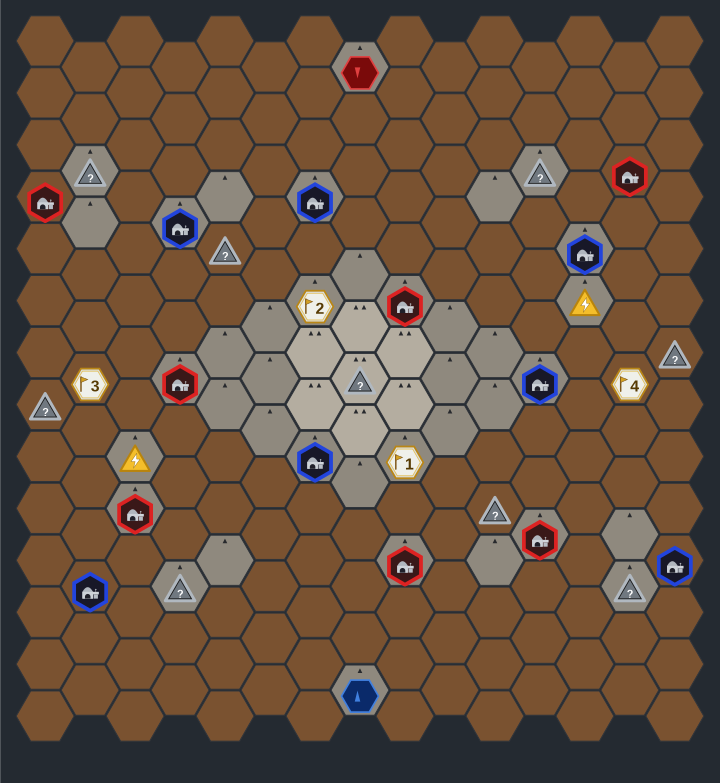
Setup steps
- Place the game board in the center of the play space.
- Place both players' Bases in the indicated positions.
- Place both players' Garrisons in the indicated positions.
- Place the neutral Objectives in the indicated positions.
- Randomly place the Upgrades face down in the indicated positions.
- Place the scenario goal card within sight of both players.
- Each player reveals their squad, arranges their unit cards, and places their units' Timeline tokens on the Timeline track.
- Each player shuffles their Tactics card deck and draws three cards to form a hand, leaving the rest face down.
- Place the round token on the lowest round number containing a Timeline token and begin the game with the topmost unit on the stack. If multiple players have units on the same round, each player rolls an attack die, and the player who rolls the higher number goes first. (Roll again if both rolls are the same.)
Recommended starter squads
You may choose any three units to form your squad in this scenario, but if you are still learning how to play, try using the recommended squads and decks below.
Player 1 Squad
- RX-78-2 Gundam (Legendary Hero)
- Wing Gundam Zero (EW) (Wing of Destruction)
- Gundam Barbatos Lupus Rex (Final Stand)
Player 1 Tactics Cards
Epic Shot / Sacrificial Overload / Iron-Blooded Tenacity / Thrust Boosters / Hero's Might / Field Engineers / Armor Shatter / Quick Block / Breaking Blow
Player 2 Squad
- Char's Zaku II (Fast Encounter)
- Gundam Epyon (EW) (Crimson Dragon)
- Gundam Vidar (Cold Justice)
Player 2 Tactics Cards
Crimson Execution / War Edge / Claiming Vengeance / Renewed Power / Armor Upgrade / Ghost Step / Neutralize / Limiter Release / Strikethrough
Azure Fang
Victory points
| Scored at the end of each Phase | VP |
|---|---|
| Objectives 1, 2, 3 & 4 | 5 VP each |
| Defeat an enemy unit | its VP value |
| Defeat an enemy Garrison / Rescue an allied Garrison | 2 VP |
Holding every Objective at the end of a Phase scores 20 VP; both Phases, 40 VP.
Goal
- Secure the supply crates (Objective tokens) in and around the lake.
- Supply crates must be picked up and carried by a unit in order to control them.
- They ignore the rules for contesting and take control of the Objective immediately, regardless of enemy units or the state of the Objective.
Scenario rules
Neutral Objective tokens are treated as “supply crates” in this scenario and can be picked up and transported by units. At the end of each Phase, earn 5 VP for each supply crate held by your units.
- When a unit ends its action on (not adjacent to) a hex containing a supply crate, that unit can pick up the supply crate. When picked up, remove the supply crate from the game board and place it on the appropriate unit card.
- Each unit may only carry one supply crate at a time.
- Units may drop supply crates at any time. When dropped, place the supply crate's token on the hex where the unit is currently located. Supply crates that have been dropped are no longer under that player's control.
- When a unit Dashes, or is Pushed or Pulled, it automatically drops any supply crates it is carrying onto the hex where it is positioned when the action occurs.
- When a unit is defeated, any supply crates it was carrying are dropped in the hex where it was defeated. The unit is then removed from the game board.
Victory condition
The player with the most victory points at the end of Phase 2 wins the game. If both players end Phase 2 with the same amount of points, the player whose unit acted last wins the game.
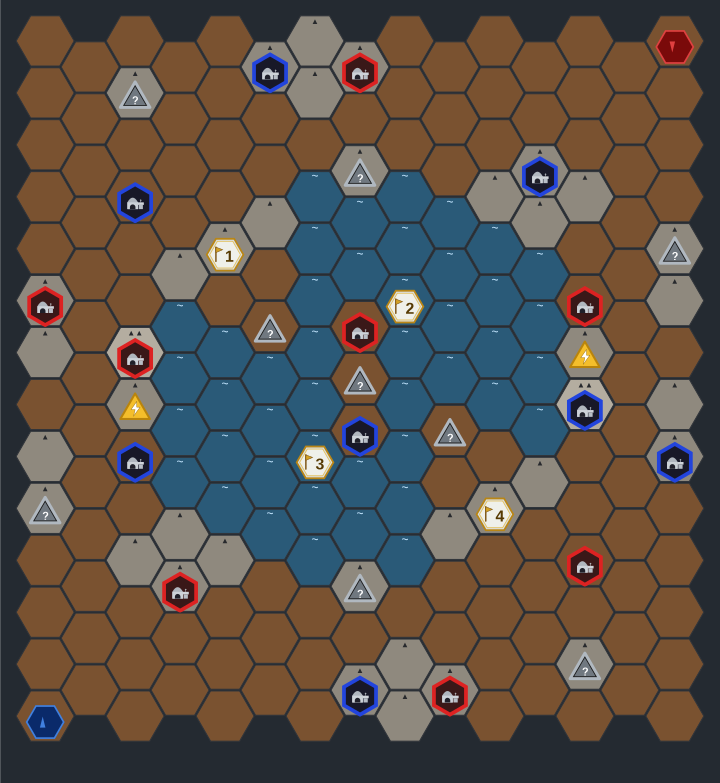
Setup steps
- Place the game board in the center of the play space.
- Place both players' Bases in the indicated positions.
- Place both players' Garrisons in the indicated positions.
- Place the neutral Objectives in the indicated positions.
- Randomly place the Upgrades face down in the indicated positions.
- Place the scenario goal card within sight of both players.
- Each player reveals their squad, arranges their unit cards, and places their units' Timeline tokens on the Timeline track.
- Each player shuffles their Tactics card deck and draws three cards to form a hand, leaving the rest face down.
- Place the round token on the lowest round number containing a Timeline token and begin the game with the topmost unit on the stack. If multiple players have units on the same round, each player rolls an attack die, and the player who rolls the higher number goes first. (Roll again if both rolls are the same.)
Operation Lockdown
Victory points
| Scored at the end of each Phase | VP |
|---|---|
| Objective 1 | 8 VP each |
| Objectives 2, 3 & 4 | 5 VP each |
| Defeat an enemy unit | its VP value |
| Defeat an enemy Garrison / Rescue an allied Garrison | 2 VP |
Holding every Objective at the end of a Phase scores 23 VP; both Phases, 46 VP.
Goal
- Control of these districts is crucial: failure will mean loss of the city.
- Critical City Positions: Secure critical positions (Objective tokens) within the city following the standard rules for contesting and controlling Objectives.
Scenario rules
Secure Critical Positions
Secure critical positions (Objective tokens) on the outskirts of the city and within the city center following the standard rules for contesting and controlling Objectives. Each position you control at the end of a Phase will award victory points as described below.
- The central position (1) at the heart of the city is worth 8 victory points.
- Each of the positions on the city outskirts (2, 3, 4) are worth 5 victory points.
Victory condition
The game ends at the end of two Phases, after which the player with the most victory points is declared the winner.
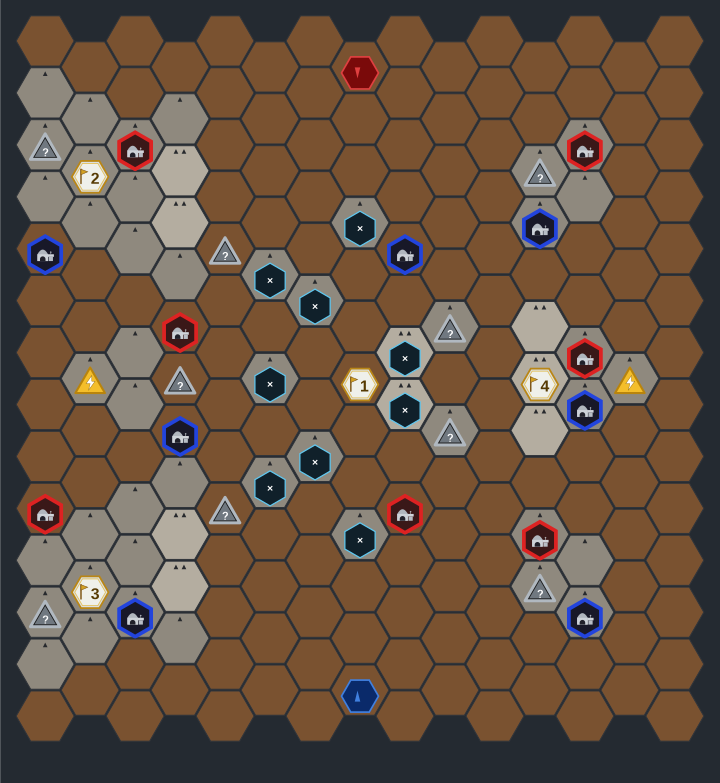
Setup steps
- Place the game board in the center of the play space.
- Place both players' Bases in the indicated positions.
- Place both players' Garrisons in the indicated positions.
- Place the neutral Objectives in the indicated positions.
- Randomly place the Upgrades face down in the indicated positions.
- Place the Energy tokens in the indicated positions.
- Place the Impassable Terrain tokens in the indicated positions.
- Place the scenario goal card within sight of both players.
- Each player reveals their squad, arranges their unit cards, and places their units' Timeline tokens on the Timeline track.
- Each player shuffles their Tactics card deck and draws three cards to form a hand, leaving the rest face down.
- Place the round token on the lowest round number containing a Timeline token and begin the game with the topmost unit on the stack. If multiple players have units on the same round, each player rolls an attack die, and the player who rolls the higher number goes first. (Roll again if both rolls are the same.)
Operation Gravedigger
Victory points
| Scored at the end of each Phase | VP |
|---|---|
| Objective 1 | 5 VP each |
| Objectives 2 & 3 | 8 VP each |
| Defeat an enemy unit | its VP value |
| Defeat an enemy Garrison / Rescue an allied Garrison | 2 VP |
Holding every Objective at the end of a Phase scores 21 VP; both Phases, 42 VP.
Goal
- Secure the reactors for immediate resource extraction.
- Destroyed ships: Secure the destroyed ships (Objective tokens) scattered throughout the salvage zone.
- Fusion Charges: Units that move onto interaction points gain 2 Fusion Charge tokens.
- Interaction Point = 2 red or 2 blue Fusion Charge tokens.
- COMMAND: Up to 2 Fusion Charge tokens can be placed on empty hexes within Range 3.
Scenario rules
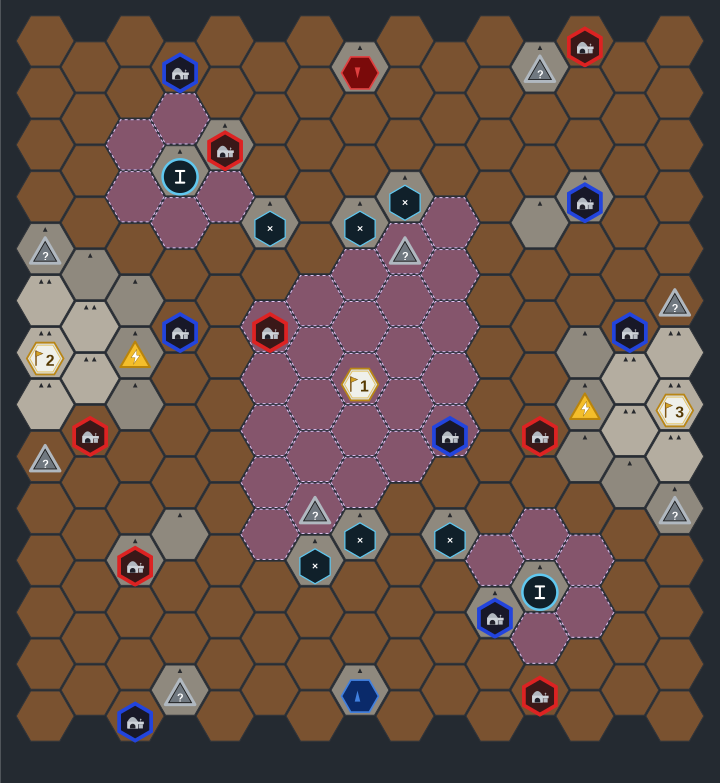
Destroyed Ships
Secure the destroyed ships (Objective tokens) scattered throughout the salvage zone. Each ship you control at the end of a Phase is worth victory points as described below.
- The ship in the center of the Minovsky Particles (1) is worth 5 victory points.
- The ships at the edges of the salvage zone (2, 3) are each worth 8 victory points.
Fusion Charges
This scenario features two Interaction Points representing abandoned munition caches containing Fusion Charges. Any unit may end their movement on one of these caches to collect two Fusion Charge tokens that can later be placed in hexes on the battlefield.
When a unit ends its movement on an Interaction Point, remove the Interaction Point from the board and then collect two Fusion Charge tokens and place them on the corresponding unit card.
Once a unit has collected Fusion Charges, that unit gains the following additional ability:
COMMAND: Place up to 2 Fusion Charges on empty hexes within Range 3.
Once placed, these Charges will detonate when an enemy unit ends any movement on or adjacent to them, as shown on the card here. Once detonated, Fusion Charges are removed from the game.
Fusion Charges card
After an enemy unit ends a movement on or adjacent to an allied Fusion Charge: Detonate that Fusion Charge–The unit that placed it deals Damage 1 to each enemy on or adjacent to it and applies Fracture to those enemies. Then, remove the Fusion Charge token from the game.
Victory condition
The game ends at the end of two Phases, after which the player with the most victory points is declared the winner.
Setup steps
- Place the game board in the center of the play space.
- Place both players' Bases in the indicated positions.
- Place both players' Garrisons in the indicated positions.
- Place the neutral Objectives in the indicated positions.
- Randomly place the Upgrades face down in the indicated positions.
- Place the Interaction Point tokens in the indicated positions.
- Place the Energy tokens in the indicated positions.
- Place the Impassable Terrain tokens in the indicated positions.
- Place the scenario goal card and Fusion Charges card within sight of both players.
- Each player reveals their squad, arranges their unit cards, and places their units' Timeline tokens on the Timeline track.
- Each player shuffles their Tactics card deck and draws three cards to form a hand, leaving the rest face down.
- Place the round token on the lowest round number containing a Timeline token and begin the game with the topmost unit on the stack. If multiple players have units on the same round, each player rolls an attack die, and the player who rolls the higher number goes first. (Roll again if both rolls are the same.)
Scenario text and maps from the fan reference at gundam-rules.com (scenarios as of 20 November 2026).
Official FAQ
All 130 official questions and answers, captured . Pick a topic or use the search bar.
Glossary
Official definitions, Core Rulebook p.47–53.
Ability
Printed on unit cards; some require Energy. Abilities need Line of Sight unless stated. Tactics card effects are also abilities.
Activation
The span from when you start using a unit's actions to when you finish.
Additional
Extra actions (Advance, Attack, Dash, Rescue and so on) granted by abilities, on top of the Primary Action.
Advance
Standard move action, up to 3 hexes. Card and ability Advances are in addition.
Ally (allied)
A unit, Garrison, Remote Weapon System or structure that belongs to you.
Area of Effect
Affects a predefined area shown by a diagram of the acting unit's position and the affected hexes.
Attack Dice
Roll dice equal to the weapon's Strength, plus or minus modifiers.
Away
Each hex moved must be farther from the unit or object than the previous one, counted in hexes.
Capture
Successfully contesting a neutral Objective captures it (place a control token). Effects that say "capture" take control immediately regardless of adjacent units or current state.
Carrier
A unit used in some scenarios, following most unit rules with exceptions.
Challenge
Lets a unit swap places with an ally to become the target of an attack. If the defending ally can't swap, Challenge can't resolve and the ally stays the target.
Collision Damage
From Push or Pull. Hitting a structure or terrain: 2 damage. Hitting another ally or enemy: all parties take 2. Units defeated by the attack that pushed them still collide. Shields prevent collision damage.
Combat Damage
Damage from hits on attack dice, crit effects that modify attack damage, and Fracture.
Contest
Ending an activation on or adjacent to an Objective contests it.
Critical Hit
A 9 or 10 on a die. Hits regardless of Accuracy and can trigger the weapon's crit effect; some need multiple crits.
Deactivated
A Shield that prevented damage. It can't prevent more until the owning unit next activates. Some abilities also deactivate Shields.
Deploy / Redeploy
First activation, or first activation after defeat: place the unit from a Base or Carrier.
Disarm
Next attack re-rolls all hits and can't trigger crit effects. Triggers After Attack Roll, after the attacker's other abilities.
Engaged
Adjacent to an enemy unit or Garrison at the same elevation. −1 hex to movement started while Engaged; must target at least one Engaged enemy when attacking.
Fracture
Next time it takes 3+ combat damage from one attack, it takes 3 more. Triggers when damage is dealt.
Garrison
Placed by scenarios. Rescue allied ones or defeat enemy ones for VP. They block movement and LoS and cause Engagement like units.
Hit Points
Units, Garrisons, RWS and Carriers have HP. At zero they are defeated.
Hover
Ignores terrain and elevation penalties while moving, and may pass through Impassable Terrain.
Jump
Starting a move on elevated terrain lets a unit bypass intervening terrain and lower enemies.
Line of Sight
Needed for attacks and abilities with a defined range. Draw centre to centre. Allies never block; enemy units, Garrisons and structures block only at the same elevation as both units.
Mass Produced
Any number with the same card number may be fielded, up to the scenario's unit count.
Move
Ability-granted movement, separate from Advance or Dash. Affected by enemies and terrain. Optional, and you can stop short.
Movement Types
All of these count as movement and can trigger movement-based abilities: Advance, Dash, Move, Pull, Push, Reposition, Swap.
Non-Combat Damage
Any damage that isn't from attack hits, damage-modifying crits or Fracture, including collision damage.
Phase
Two per game, 10 rounds each. VP is scored at the end of each Phase as the scenario dictates.
Primary
Keyword on some Tactics cards: playing the card counts as the unit's Primary Action.
Pull
Moved toward the source, ignoring normal movement modifiers. Can't Pull an enemy already adjacent at the same elevation. Can cause collision damage.
Push
Moved away from the source, ignoring normal movement modifiers. Can cause collision damage.
Range
Weapons can't attack beyond their range. Anything with a stated range also needs Line of Sight.
Reinforcements
Some units deploy Reinforcements: tokens on the board and the Timeline. They count as units. When defeated, remove both tokens; they can't be redeployed.
Remote Weapon System (RWS)
- Deploy or reposition only to an empty hex.
- Don't block LoS or movement; units can't end movement in their hex.
- Aren't units: no Engagement, don't count for Objectives.
- Can be attacked, destroyed, Pushed and Pulled (and cause collision damage).
- Immune to status effects.
- When destroyed they return to the deploying unit's supply for later use. A unit can't deploy more than its supply.
Reposition
Remove from the current hex and place in a new one as directed. Counts as movement.
Reserve
Off-board area where units start and return when defeated. Can't be attacked or gain status effects there.
Response
Used only on its stated trigger and resolved entirely before play resumes.
Shield
Prevents 1 damage from an attack or ability, then deactivates until the unit next activates.
Signature Tactics Cards
Usable only by the named unit, which counts as the source of the card's effects.
Status Effects
Applied by tokens. Only affect units, not Garrisons or RWS.
Structure
Bases and other scenario structures. Enemy structures generally block movement and LoS.
Swap
Exchange the positions of the miniatures involved. Counts as movement.
Terrain Movement Penalties
Both the elevation climb penalty and special terrain penalties such as water.
Timeline Penalty
A defeated unit immediately moves 2 spaces up the Timeline.
Trait
Pilot, faction or characteristic tags. Referenced by abilities and deck-building rules.
Unit
A Mobile Suit, Carrier or other combatant with a unit card. Not Garrisons or RWS.
Attack Roller
1 always misses; 9–10 always crit. Crit effects trigger once per attack. Shields are applied last; Fracture adds +3 when the attack deals 3 or more.
Expected hits at this Accuracy
Timeline Counter
1. Tap the space the unit is on now
Costs wrap past space 10 back to space 1. More than 10 TL in one activation pushes the unit into the next Phase. Land on allies: your token goes to the bottom of the stack.
Event Formats
From the Organised Play Reference Guide v1.0.1 (Wave 1: Sept 18, 2026 to Jan 31, 2027). Player-facing rules only; organiser administration is left out.
Event levels at a glance OPRG 1.2, 2.2
| Format | Lvl | Players | Structure | Squad | Clock |
|---|---|---|---|---|---|
| Learn to Play Event | 1 | 1–4 per demonstrator wave | Scripted demo, no results | Provided | No |
| Standard Friendly Battle | 2 | 4–16 | 3 × Bo1 Swiss, pairings only | 3 MS / 9 cards, may change between rounds | No |
| Duel Night | 2 | 2 | One Bo3 match, max 3 games | 3 / 9, may change between games | No |
| Friendly Cup | 3 | 4+ | 3 × Bo1 Swiss, no Top Cut | One locked 3 / 9 | 30:00 each |
| Challenger Cup | 3 | 4–32 | 3 × Bo1 Swiss + Top Cut by attendance | Three 4 / 12 pools, pick 3 / 9 secretly | 30:00 each |
| Challenger Cup Plus | 3 | 32–512 | Swiss (6 or 9 rounds) + Top 8 | Three 4 / 12, used in rotation | 30:00 each |
Challenger Cup Plus is not offered during Wave 1.
Squad rules by format OPRG 6.7
- Friendly Battle: exactly 3 Mobile Suits and 9 Tactics cards before each round or game; may change between rounds. A Starter-Only track may restrict products.
- Friendly Cup: register one 3/9 Squad by check-in close; it locks when Round 1 pairings are generated and stays the same for all three rounds.
- Challenger Cup: register three Squads of 4 Mobile Suits and 12 Tactics cards, assign one per Swiss round, and before each match secretly select a legal 3/9 from the assigned pool.
- Challenger Cup Plus: three 4/12 Squads; each must be used once before any repeats.
- No duplication of Mobile Suits or Tactics cards across your three registered Squads. A named Mass Produced suit may appear in only one of them.
- After lock, pools and assignments are open information. Before shuffling, your opponent may check your selected 9 cards against your registered pool.
Round timing OPRG 6.8
- Friendly Battle: 60 minutes recommended per round (per game at Duel Night).
- Level 3: 5 minutes for squad selection and verification, then 60 minutes of game time split equally on the chess clock.
- Time warnings at about halfway, 15 min, 5 min and time.
End of round & ties OPRG 6.8.4, 6.15.4
At time, finish the current activation, stabilise the game state, and don't start another activation. Higher VP wins.
- Tied Swiss or Friendly Battle game: draw.
- Tied Top Cut game: the player who took the second turn wins. Top Cut games can't draw.
Chess clocks OPRG 6.9
- Required for every Level 3 match: 30:00 per player. Physical clocks or a common public clock app; no custom or modified apps.
- The clock runs for whoever is progressing the game: acting, measuring, resolving choices, shuffling, deciding. Pass it promptly when responsibility changes.
- Pause both clocks for a judge call. Ordinary thinking, rules searches and shuffles stay on your own time.
- A failed clock with unknown times: split remaining time equally. Never reset both to 30:00 mid-game.
Match points & standings OPRG 6.14
| Result | Match points |
|---|---|
| Win | 3 |
| Draw (genuinely tied game) | 1 |
| Loss | 0 |
| Natural bye | 3 |
Tiebreakers in order: Match Points, then OMW%, then OOMW%, then a supervised random tiebreak. VP differential and total VP are not tiebreakers.
Top Cut OPRG 6.15
| Challenger Cup attendance | Top Cut |
|---|---|
| 4–8 | None |
| 9–16 | Final |
| 17–24 | Top 4 |
| 25–32 | Top 8 |
Before Top Cut pairings, assign your three registered Squads to Top 8, Top 4 and Final (each once, unchanged), even if a stage won't be played.
Late players & drops OPRG 6.10, 6.13
- Level 3: at the start of the game the present player starts the absent player's clock. Arrive within 5 minutes and set up on your own time. At 5 minutes, call a judge: no-show and match loss.
- Friendly Battle: up to 5 minutes late, play with the time left. More than 15 minutes late without contact is normally a no-show.
- Tell the organiser before the next pairing if you want to drop. No re-entry at Friendly Cup or Challenger Cup.
- Intentional draws, bribery and result engineering are prohibited.
Notes, devices & assistance OPRG 5.6
- L1–L2: private strategy notes and outside strategy material are allowed (no live coaching).
- L3: no private notes. No strategy lookups or coaching messages on devices.
- Devices are fine for the official Rulebook and official documents, event admin, and timers. This page counts as a personal reference, so check with the judge before using it at L3.
- Spectators must not give strategic advice. A judge clarifying rules is not outside assistance.
Sleeves, shuffling & dice OPRG 7.8–7.9
- Sleeves: optional at L1–L2, required at L3. Opaque, identical, same direction. Double-sleeve all or none. Nothing extra inside. Bring spares.
- Shuffling: shuffle thoroughly in view; pile shuffling alone isn't enough. At L3, present the deck for the opponent to cut or shuffle, and no further randomising after that unless an effect requires it.
- Dice: third-party and custom dice are fine if fair and readable. Roll onto the table or a tray in view of both players. Reroll dice that land off the table or are cocked. Don't use a "special" die only for key rolls.
Models & Mass Produced clarity OPRG 7.3–7.7
- No proxies (including 3D prints) at sanctioned events. Use official bases.
- Minor conversions are OK: third-party bits up to roughly 20% of the model, same silhouette and footprint.
- Broken model: quick repair, a same-unit replacement, or play on with that suit absent. You can't swap in a different suit.
- Several of one Mass Produced suit: mark them visibly (numbered bases, base-rim colours) and explain the model ↔ token ↔ card mapping to your opponent before play.
Judge calls & penalties OPRG 1.5, 6.11–6.12, 9.3
Call a judge when a rules interaction can't be settled calmly, the game state, a clock or a squad seems wrong, or you suspect slow play or outside assistance. Stop taking actions while a ruling is pending. Where a Head Judge exists you can appeal to them, and their decision is final onsite.
Errors are fixed by a reliable rewind to the last clear legal point, or by a fix-forward to the closest fair state.
Sanction ladder: education/soft fix, caution, warning (recorded), game loss, match loss, disqualification, removal, programme referral. In Bo1 a game loss equals a match loss.
Eligibility: new products are legal on release day at L1–L2, and 7 days after regional release at L3.
Sources & What's Missing
Built from
- Official Core Rulebook v1.2, updated November 06, 2026 (full rules and glossary).
- Organised Play Reference Guide (L1–L3) v1.0.1, Wave 1 (player-facing sections).
- Card data: unofficial transcription of Bandai's card list at gundam-assemble.online/cards (units and RWS).
- Tactics cards (all 45) and the official FAQ (130 entries, captured 13 November 2026): fan reference at gundam-rules.com.
- Area-of-effect patterns: from your printed cards (War Edge from the gundam-rules.com description).
Wording is condensed for the table. If anything here disagrees with the official documents, the official documents win.